


JustitActive Recruit
- Joined
- Jun 2025
- Messages
- 162
Why Berkshire’s has a portfolio like this?
Unlikely they are not aware of all the above… or can it be the case?
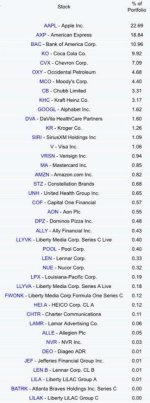
Concentration risk is through the roof: the top 5 positions represent 2/3 of the total exposure.
Any portfolio this top heavy is exposed to single issuer drawdowns: what every good diversified portfolio should avoid in the first place.
Chances of Apple to experience a regulatory hit or a valuation compression are real, and would cause a volatility spike to the whole portfolio. Such level of concentration is entirely avoidable.
Sector imbalance is huge, with financials dominating, followed by energy. Consumer staples and discretionary do not offset the systemic nature of financials and energy bets. If credit markets tighten or commodity prices move violently, the portfolio moves with them.
No real diversification into countercyclical sectors.
Exposure to genuine growth sector is minimal outside Apple. Long term opportunity cost is therefore high. Missing secular growth is a form of risk.
Geographic concentration is embarrassing, being 100% USA. The whole risk is tied to US monetary policy, regulation, sector cycles.
Portfolio beta is a bit below 1, just because the stocks picked are large and stable.
No hedge against inflation (other than energy) or deflation. No hedge against geopolitical tail risks.
This portfolio lives or dies with the U.S. corporate environment.
There’s no reasoning, no planning, no philosophy behind this portfolio.
In short, it’s a nonsense.
Whose portfolio is this?
Berkshire’s.
Why Berkshire’s has a portfolio like this?
Unlikely they are not aware of all the above… or can it be the case?
Justit said:Why Berkshire’s has a portfolio like this?
Unlikely they are not aware of all the above… or can it be the case?
Because Mr. Buffett and Mr. Munger were two lucky guys with a lot of cash to invest. The market followed their money, turning their predictions into reality - the "Buffett effect".
You don’t have to be a genius to buy a bunch of mega cap companies, especially when everyone else copies what you do because media call you “the oracle”.
Nobody is smarter than the market.
The real genius is the one who bought AAPL, MSFT, GOOG, AMZ and BTC in the first couple of years of their existence. Just these 5, nothing else; easy, no?
Guess what, such person doesn’t exist.
Look at the MonteCarlo fallacy to understand why Warren Buffett is not extraordinary. It would actually be very strange if a Warren Buffett didn’t exist.
I suggest to read chapter 10 of “Fooled by randomness” by N. N. Taleb.
The full book can be found here: Full text of "Fooled By Randomness Nassim Taleb"
I would also love to see @igriv resuming his feud with Taleb here 😏
JohnnyDoe said:I suggest to read chapter 10 of “Fooled by randomness” by N. N. Taleb.
The full book can be found here: Full text of "Fooled By Randomness Nassim Taleb"I would also love to see @igriv resuming his feud with Taleb here 😏
Can’t wait!!
Those are all valid criticisms. Though there is always one universal mitigating factor: if you win.
Some of this is intentional choice based on their investment philosophy. “Invest in companies you understand.” “Don’t bet against America.” Etc.
Those two have consistently made money over many decades. They didn’t have one big strike. That’s worth consideration. Their methods and strategies won’t work for everyone and won’t always be relevant to the current environment. It’s necessary to learn new things and re-evaluate.
In general, experts tend to understand the underlying axioms of the rules they use and develop and understand when to follow them and when to break them. That might be the case here, or it might not.
Easy to win when you are every day on the media and the public replicates what you do.
True power moves in silence.