
ColumbusActive Recruit
- Joined
- Jun 2025
- Messages
- 125
Me thinking 🤔 : WTF instead of using it, start an anti detection browser biz 😉
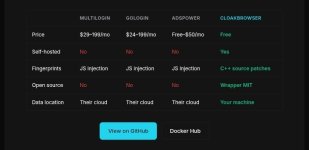
Not a patched config. Not a JS injection. A real Chromium binary with fingerprints modified at the C++ source level. Antibot systems score it as a normal browser — because it is a normal browser.
Drop-in Playwright/Puppeteer replacement for Python and JavaScript. Same API, same code. 3 lines of code, 30 seconds to unblock.
Others charge $49–299/month for this. CloakBrowser is free.
Website. CloakBrowser — Stealth Chromium for Browser Automation
Columbus said:Interesting, another stealth browser. They still use playwright. Every stealth/multi-login browser uses playwright or puppeteer.
They just modify some flags😁.
Anyways there will always be ways to bypass antibot systems😁.
What matter is the source code is public open available.
They support both : Puppeteer & Playwright. FAQ they mentioned them.
They support Python:
from cloakbrowser import launch
browser = launch()
page = browser.new_page()
page.goto("protected-site.com") # no more blocks
browser.close()
JavaScript (Playwright):
import { launch } from 'cloakbrowser';
const browser = await launch();
const page = await browser.newPage();
await page.goto('https://protected-site.com');
await browser.close();
Also works with Puppeteer: import { launch } from 'cloakbrowser/puppeteer
Why CloakBrowser?
Config-level patches break — playwright-stealth, undetected-chromedriver, and puppeteer-extra inject JavaScript or tweak flags. Every Chrome update breaks them. Antibot systems detect the patches themselves.
CloakBrowser patches Chromium source code — fingerprints are modified at the C++ level, compiled into the binary. Detection sites see a real browser because it is a real browser.
Source-level stealth — C++ patches handle fingerprints (GPU, screen, UA, hardware reporting) at the binary level. No JavaScript injection, no config-level hacks. Most stealth tools only patch at the surface.
Same behavior everywhere — works identically local, in Docker, and on VPS. No environment-specific patches or config needed.
Works with AI agents and automation frameworks — drop-in stealth for browser-use, Crawl4AI, Scrapling, Stagehand, LangChain, Selenium, and more. See integrations.
CloakBrowser doesn't solve CAPTCHAs — it prevents them from appearing. No CAPTCHA-solving services, no proxy rotation built in — bring your own proxies, use the Playwright API you already know.
Columbus said:nope, they use this as marketing.
They did not open source everything. The patches are closed source. Read BINARY-LICENSE.md
I know, you know also, no (BH) from Russia, China, North Korea will respect that license.
Columbus said:It’s not about the license. My point was that it is not fully open source. That file contains some information about the missing open source code. 😏
The reason I share this tool is to be free from the limitations of cloud browsers and to maintain privacy in the first place, I accept 80% open source no problem at all.
Vizier · 7 replies · last 13 Nov 2026
Virtualine · 8 replies · last 2 Nov 2026
Laid Back Llama · 4 replies · last 30 Oct 2026
Vizier · 0 replies · last 24 Oct 2026
True power moves in silence.